What Is Dutch Elm Disease?
Dutch elm disease (DED) is caused by two closely related fungal pathogens: Ophiostoma ulmi, which arrived in North America in the 1920s, and the more aggressive Ophiostoma novo-ulmi, which displaced it beginning in the 1970s. Today, O. novo-ulmi is responsible for the majority of elm losses across Canada.
The fungus colonizes the elm's vascular system — the xylem tissue responsible for transporting water from roots to leaves. As the fungus spreads, it blocks this flow. The tree responds by producing tyloses, gel-like deposits that further obstruct water movement in an attempt to wall off the infection. The result is wilting and death of affected branches, progressing toward the whole tree if not interrupted.
The disease spreads in two primary ways: through the feeding and breeding activity of elm bark beetles carrying fungal spores, and through grafted root connections between neighbouring elms. Root transmission is particularly significant in dense urban plantings where roots of adjacent trees have fused over decades.
Stage 1: Flagging
The first visible symptom is flagging — sudden wilting of leaves on one or more branches while the rest of the tree appears healthy. Affected branches look as though the leaves have not received water, which is essentially what is happening: the fungal infection has blocked xylem flow to that section.
Flagging typically appears from late May through August in most Canadian provinces, coinciding with the feeding and flight activity of bark beetles. In Alberta and Saskatchewan, the window may shift slightly based on seasonal temperatures.
A key diagnostic point: flagging caused by DED tends to be sudden. A branch that looked normal one week may show curled, wilting leaves the next. Stress-related wilting from drought or construction damage usually develops more gradually across a larger portion of the canopy.
Flagging alone is not conclusive evidence of DED. Branches can wilt for several reasons, including soil compaction, girdling roots, and other fungal infections. Confirmation requires internal inspection of the sapwood.
Stage 2: Sapwood Discolouration
The diagnostic step after identifying flagging is to cut a twig from an affected branch and examine the cut surface. Healthy elm sapwood is cream or pale white. In a DED-infected branch, the outer ring of sapwood — the current growth layer just beneath the bark — will show brown or olive-green streaking. This discolouration follows the xylem vessels and may appear as a ring of spots or a continuous arc depending on how far the infection has progressed.
The discolouration results from the tree's own defensive response (the tyloses mentioned above) combined with metabolic byproducts of the fungal growth. It is consistently present in DED-positive material and is the most reliable field indicator available to a non-specialist.
When taking a twig sample, select material from the boundary between symptomatic and apparently healthy tissue — ideally 10 to 30 cm back from where wilting begins. This is where the fungal front is most likely to be active.
How to Perform a Twig Cut
- Identify a branch showing wilting or leaf curl.
- Select a pencil-diameter twig at the junction between the flagging area and green growth.
- Make a clean cross-section cut with sharp pruners or a knife.
- Examine the outer ring of wood tissue immediately inside the bark.
- Brown or olive-green spotting or arcing in that ring is a positive indicator for DED.
Stage 3: Bark Beetle Galleries
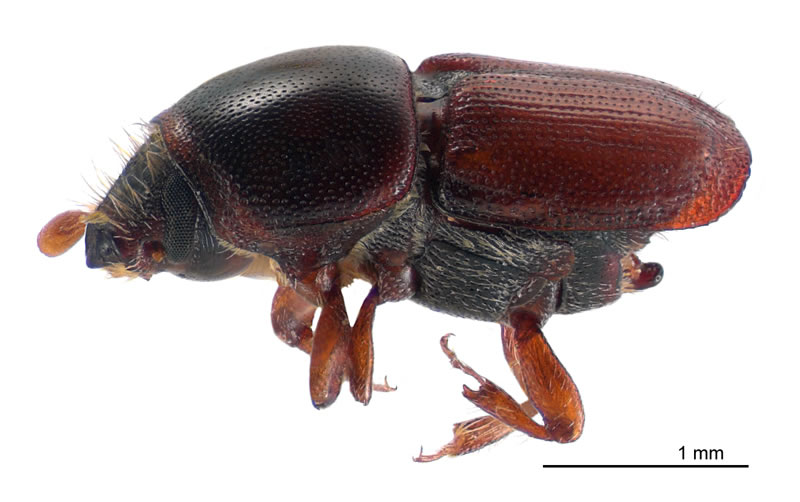
Elm bark beetles — specifically Scolytus multistriatus (European elm bark beetle) and Hylurgopinus rufipes (native elm bark beetle) — breed under the bark of weakened or recently dead elm wood. Their egg-laying and larval tunneling create distinctive gallery patterns: a central egg-laying channel from which larval feeding galleries fan outward in a pattern sometimes compared to a centipede.
On the exterior of infested bark, the first visible signs are small entry holes (roughly 1–2 mm in diameter for adults) and fine powdery frass at the base of branches or around the entry points. Peeling away a section of loose or cracked bark on a symptomatic branch may reveal these galleries directly.
Adult beetles emerging from infected elm wood carry O. novo-ulmi spores in specialized structures on their bodies. When they feed on healthy elm twigs (a behaviour called maturation feeding), they introduce these spores directly into the xylem tissue. This is the primary mechanism of tree-to-tree transmission across the urban forest.
Distinguishing DED from Other Elm Conditions
Several other conditions produce symptoms that can be confused with DED at first glance:
- Elm yellows (phytoplasma disease): Causes yellowing of the entire canopy rather than isolated flagging, and typically progresses more slowly. Internal sapwood discolouration is not present.
- Drought stress: Produces uniform wilting across the canopy, often worse on the south and west sides of the tree. Sapwood is not discoloured.
- Verticillium wilt: Can produce vascular discolouration similar to DED. Differentiation often requires laboratory analysis.
- Elm leaf beetle feeding: Causes defoliation and skeletonized leaves, but no vascular symptoms. Frass and feeding damage on leaf surfaces is distinct from bark beetle activity.
When sapwood discolouration is present alongside flagging in early to mid-season, DED becomes the primary working diagnosis. Laboratory confirmation through fungal culture or molecular testing is available through provincial agricultural laboratories and some municipal forestry programs.
What to Do After Identifying Symptoms
If a tree on your property shows symptoms consistent with Dutch elm disease, the next step is contact with a certified arborist or your local municipality's urban forestry department. Many Canadian municipalities with active elm management programs — including Winnipeg, Edmonton, and Calgary — have reporting systems for suspected DED. Early reporting allows for coordinated sanitation and, in some cases, targeted fungicide injection for high-value specimens.
Movement of elm wood from suspected trees is regulated in many jurisdictions. Under CFIA guidelines, elm wood and firewood may not be transported across certain provincial boundaries. Check local bylaws before removing or relocating elm material.