The Two Primary Vectors
Dutch elm disease does not move from tree to tree on its own. The fungal pathogen Ophiostoma novo-ulmi relies on two bark beetle species to carry spores into fresh host tissue:
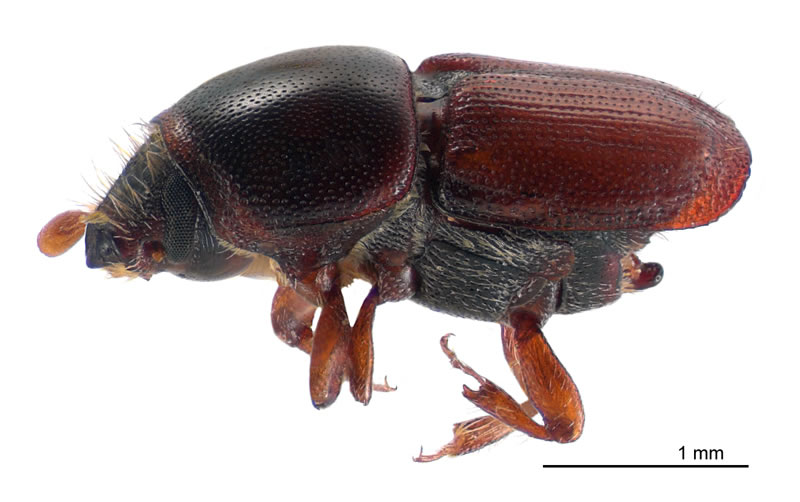
- Scolytus multistriatus — the European elm bark beetle, introduced to North America in the early 20th century and now established throughout the continent's elm range.
- Hylurgopinus rufipes — the native elm bark beetle, present across the elm range in North America before the arrival of DED.
Both species breed under the bark of weakened or recently dead elm material. Both carry fungal spores and can transmit the disease during their feeding behaviour on healthy elms. S. multistriatus tends to be more abundant in urban settings, while H. rufipes is more common in rural and forested areas.
Life Cycle of Scolytus multistriatus
Scolytus multistriatus typically completes one to two generations per year in Canada, depending on latitude and seasonal temperatures. In warmer regions such as southern Ontario, two generations are possible in a single season. In Manitoba and Saskatchewan, a single annual generation is more typical.
Spring Emergence and Maturation Feeding
Adult beetles overwinter as larvae in the phloem layer beneath elm bark. As temperatures rise in spring — generally when sustained daily highs reach around 15–18°C — adults complete development, chew exit holes through the bark, and emerge. This typically occurs from late April through June in most Canadian provinces.
Newly emerged adults are not yet sexually mature. Before breeding, they undergo a maturation feeding period: they seek out healthy elm twigs and feed in the crotches of small branches, a behaviour that serves a nutritional function for the beetle. It is during this feeding that spores picked up from previously infected breeding material are deposited directly into the elm's xylem, initiating infection. A single beetle carrying spores can introduce DED to a healthy tree during this phase.
Breeding Under Bark
After maturation feeding, adult beetles seek out suitable breeding material — elm wood that is dead, dying, or significantly weakened. A female bores through the bark and excavates an egg gallery running roughly parallel to the wood grain. She lays eggs along the sides of this gallery. After hatching, larvae feed outward from the egg gallery, creating the characteristic fan-shaped pattern of tunnels visible when bark is removed.
If breeding material is infected with O. novo-ulmi, the fungal spores colonize the galleries and adhere to developing adult beetles before they emerge. These adults then carry viable spores when they begin their own maturation feeding on healthy elms, continuing the transmission cycle.
Late Summer Generation
In areas where two generations occur, a second emergence of adults takes place in late July through August. This second generation follows the same maturation feeding and breeding pattern. The larvae produced by this generation overwinter under the bark and emerge the following spring.
Life Cycle of Hylurgopinus rufipes
Hylurgopinus rufipes has a somewhat different phenology. Adults overwinter in the outer bark of healthy elm trees, not as larvae in breeding galleries. They emerge in early spring — often before S. multistriatus — and begin feeding. Unlike the European elm bark beetle, the native species breeds in spring and produces a single generation annually. Its biology makes it a significant early-season vector.
The native elm bark beetle creates its galleries across the wood grain, a feature that distinguishes its work from the parallel galleries of S. multistriatus when examining exposed wood.
How Populations Build
Beetle populations expand rapidly when suitable breeding material is available. Trees killed by DED, damaged by storm or construction, or weakened by compacted soil and drought provide high-quality breeding habitat. A single dead elm left in place through a breeding season can produce thousands of adult beetles, many of which will carry DED spores.
This dynamic is the reason why sanitation — the prompt removal and destruction or debarking of elm material — is a central tool in municipal DED management. Removing dead and dying elm wood eliminates the breeding sites that sustain beetle populations and thereby reduces local transmission pressure.
What Property Owners Can Observe
Most of the beetle life cycle occurs beneath the bark and is not directly visible. However, there are several observable signs associated with bark beetle activity:
- Exit holes: Small circular or oval holes (1–2 mm diameter for S. multistriatus, slightly larger for H. rufipes) on the bark surface of affected branches.
- Frass: Fine sawdust-like material accumulating around exit holes or at the base of branches. This results from adult boring activity.
- Bark splitting or loosening: In heavily infested material, the bark may separate easily from the wood, revealing galleries beneath.
- Gallery patterns: If bark is peeled from suspect material, the characteristic tunnels of S. multistriatus (central egg gallery with lateral larval galleries) or H. rufipes (cross-grain galleries) may be visible.
The presence of beetle galleries on dead or dying elm wood does not necessarily mean the beetles were carrying DED — beetles can breed in material that died from other causes. However, beetle presence on symptomatic elms is a strong indicator of combined infection and vector activity.
Transport of elm firewood across provincial boundaries is regulated by the Canadian Food Inspection Agency to prevent the movement of bark beetles and DED-infected material into areas where management programs are active.
The Role of Urban Tree Density
In cities with continuous elm canopy, root grafts between adjacent trees provide a second transmission pathway that beetles are not involved in. Once the fungus is established in one tree, it can move through connected root systems to neighbouring elms without beetle involvement. Dense urban plantings — a common feature of older Canadian neighbourhoods where elms were planted in rows — create conditions where this root transmission can be as significant as beetle-mediated spread.
Some municipal programs address root transmission through soil injection of fungicide into root graft zones, or by cutting and treating root connections between infected and healthy trees. Both approaches require professional assessment and are not typically feasible for individual property owners without municipal support.
Seasonal Monitoring Windows
Given beetle emergence and maturation feeding patterns, the highest-risk window for new DED infections in most Canadian provinces is from late May through July. Inspections during this period — looking for flagging in the canopy — give the best chance of identifying new infections while intervention may still be practical.
A second inspection in late August or September, after any second-generation beetle activity, can help identify infections that appeared later in the season and determine whether sanitation work should be scheduled before winter.

